
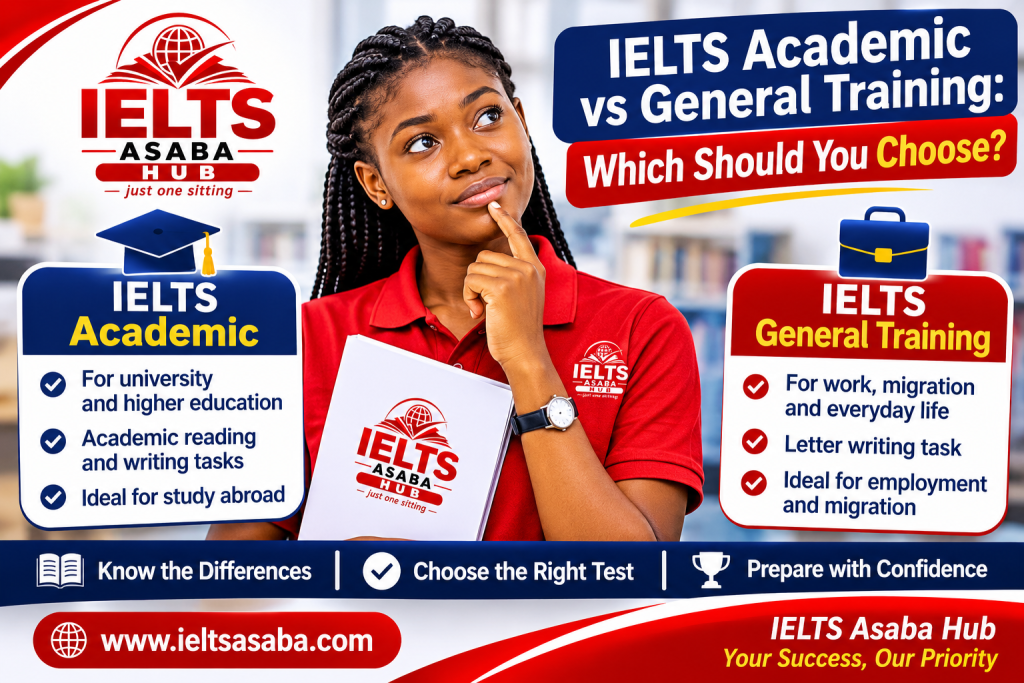
IELTS Academic vs General Training: Which Should You Choose?
Choosing the right IELTS test is an important step towards achieving your study, work or migration goals. However, many candidates are unsure whether they should register for IELTS Academic or IELTS General Training.
Although both tests assess your English-language ability, they are designed for different purposes. Choosing the wrong test could mean having to register again.
In this guide, IELTS Asaba Hub explains the differences between IELTS Academic and General Training, what each test is used for, and how to decide which one is appropriate for your plans.
What Is IELTS Academic?
IELTS Academic is designed for people who want to study at undergraduate or postgraduate level in an English-speaking environment. It is also used for certain professional registration purposes.
The test assesses whether you can understand and communicate effectively in an academic environment.
Who Needs IELTS Academic?
You may need IELTS Academic if you:
- Plan to apply to a university for an undergraduate or postgraduate programme.
- Want to study in an English-speaking country.
- Need to meet the English-language requirements of a professional registration body.
- Are applying for a programme or qualification that specifically requires IELTS Academic.
Always check the English-language requirements of your chosen university or professional organisation before registering.
What Is IELTS General Training?
IELTS General Training is designed for people who need to demonstrate their English-language ability in everyday, workplace and social situations.
It is commonly used for migration applications, work-related purposes and some forms of study or training below degree level.
Who Needs IELTS General Training?
You may need IELTS General Training if you:
- Plan to migrate to a country that accepts this test for your visa category.
- Need to meet an employer’s English-language requirements.
- Want to undertake training or study below degree level.
- Are applying for a programme that specifically requests IELTS General Training.
Migration requirements differ between countries and visa categories. Some UK visa applications, for example, require an approved Secure English Language Test (SELT), such as an appropriate IELTS for UKVI test. Always confirm the exact test accepted by the relevant immigration authority.
IELTS Academic vs General Training: Key Differences
Both tests assess four English-language skills: Listening, Reading, Writing and Speaking. However, the Reading and Writing sections are different.
| Test section | IELTS Academic | IELTS General Training |
| Listening | Same test | Same test |
| Reading | Academic-style texts | Everyday and workplace-related texts |
| Writing Task 1 | Describe visual information such as charts or graphs | Write a letter |
| Writing Task 2 | Write an essay | Write an essay |
| Speaking | Same test format | Same test format |
1. Listening
The Listening test is the same for both IELTS Academic and General Training candidates. You listen to recordings and answer questions that assess your ability to understand spoken English, including information, opinions and conversations.
2. Reading
The Reading test differs between the two versions.
Academic Reading: Candidates read three longer passages from sources such as books, journals, magazines and newspapers. The texts are designed to assess reading skills relevant to academic study.
General Training Reading: Candidates work with texts commonly found in everyday life and workplaces, as well as general-interest publications.
3. Writing
The Writing test contains two tasks in both versions, but Task 1 is different.
Academic Writing: Task 1 requires candidates to describe or summarise visual information, such as a graph, chart, table or diagram. Task 2 requires candidates to write an essay in response to a question or topic.
General Training Writing: Task 1 requires candidates to write a letter in response to a situation. Task 2 requires candidates to write an essay.
4. Speaking
The Speaking test follows the same format for both versions. It assesses your ability to communicate in spoken English through an interview with an examiner. It has three parts:
- Part 1: Introduction and questions about familiar topics.
- Part 2: A short individual talk based on a given topic.
- Part 3: A discussion related to the topic in Part 2.
Which IELTS Test Should You Choose?
Your choice should depend on the purpose of your application and the requirements of the organisation receiving your result.
If You Want to Study Abroad
If you are applying for undergraduate or postgraduate admission at a university, IELTS Academic is generally the appropriate option. However, check the university’s official English-language requirements to confirm the test and minimum band score it accepts.
If You Want to Migrate
IELTS General Training is commonly accepted for certain migration applications. However, immigration authorities have different requirements depending on the country and visa category. Some applications may require Academic, General Training or a specific approved test such as IELTS for UKVI. Check the relevant immigration website before booking.
If You Need IELTS for Employment
The correct test depends on your employer, profession and any relevant professional registration body. Some employers accept General Training, while certain professional organisations require Academic. Do not assume that one version will meet every employment requirement.
IELTS Test Duration and Scoring
Both IELTS Academic and General Training have four sections.
| Section | Approximate duration |
| Listening | 30 minutes |
| Reading | 60 minutes |
| Writing | 60 minutes |
| Speaking | 11–14 minutes |
The total test time is approximately 2 hours and 45 minutes. The Speaking test may be scheduled separately from the other sections.
IELTS uses a nine-band scoring system, from Band 1 to Band 9. Candidates receive individual scores for Listening, Reading, Writing and Speaking, as well as an overall band score. Your required band score depends on the university, employer, professional body or immigration authority you are applying to.
How Long Is an IELTS Result Valid?
IELTS results are commonly accepted by organisations for up to two years. However, IELTS does not impose one universal acceptance period on every organisation. The institution, employer or immigration authority receiving your result determines its own requirements. Check those requirements before relying on an older result.
How to Prepare for Your IELTS Test
Once you have confirmed the correct test type, the next step is to prepare effectively. Here are some practical ways to begin:
1. Understand the Test Format
Learn how each section works and the types of questions you may encounter. This helps you become familiar with the examination before test day.
2. Practise Listening Regularly
Listen to English conversations, interviews, lectures and other suitable recordings. Practise identifying important details and understanding different accents.
3. Improve Your Reading Skills
Read different types of English texts and practise answering questions within the time allowed. Learn how to identify main ideas, supporting details and specific information.
4. Develop Your Writing Skills
Practise the correct Writing tasks for your chosen test. Academic candidates should practise describing visual information, while General Training candidates should practise writing letters. Both groups should develop clear essay-writing skills.
5. Practise Speaking
Speak English regularly and practise answering questions clearly. Work on organising your ideas, using appropriate vocabulary and expressing yourself naturally.
6. Take Computer-Delivered Practice Tests
Practice tests help you understand the examination format, assess your progress and identify areas that need improvement. If you are taking a computer-delivered IELTS test, practise using a computer so that you become comfortable reading questions, entering answers and managing your time on screen.
Prepare for IELTS with IELTS Asaba Hub
Preparing for IELTS does not have to be confusing. With the right guidance, practice and learning resources, you can become more familiar with the test and work towards your target band score.
IELTS Asaba Hub provides preparation courses covering Listening, Reading, Writing and Speaking for IELTS Academic, General Training and UKVI.
Available courses include:
- IELTS Intensive Preparatory Course.
- IELTS Writing preparation.
- IELTS Reading preparation.
- IELTS Listening preparation.
- IELTS Speaking preparation.
Practise Before Your Exam
IELTS Asaba Hub also provides free computer-delivered practice tests to help candidates become familiar with the examination.
Candidates can access practice activities covering IELTS Listening, IELTS Academic Reading, IELTS General Training Reading, IELTS Academic Writing and IELTS General Training Writing. Some practice activities provide instant scores, while Writing and Speaking work can receive examiner feedback.
Whether you are preparing for IELTS Academic or General Training, start by understanding your test requirements and choosing preparation that matches your goals.
- Explore IELTS preparation courses: https://www.ieltsasaba.com/courses/
- Explore IELTS classes in Asaba: https://www.ieltsasaba.com/ielts-classes-asaba/
- Try free IELTS practice tests: https://www.ieltsasaba.com/practice-test/
- Visit IELTS Asaba Hub: https://www.ieltsasaba.com/
Frequently Asked Questions About IELTS Academic and General Training
1. Is IELTS Academic harder than General Training?
Neither test is officially described as the easier option. However, their Reading and Writing sections differ. Academic Reading uses academic-style texts, while General Training focuses more on everyday and workplace-related materials.
2. Can I use IELTS General Training for university admission?
Some institutions and programmes may accept General Training, but many undergraduate and postgraduate programmes require Academic. Check the exact requirements of your chosen institution before booking.
3. Are Listening and Speaking the same in both tests?
Yes. IELTS Academic and General Training use the same Listening and Speaking test formats. Their Reading and Writing tests are different.
4. Can I change my IELTS test type after registration?
Changes depend on the test provider’s rules, booking conditions and applicable deadlines. Contact your test provider as soon as possible if you selected the wrong test.
5. How long is an IELTS result valid?
Many organisations accept IELTS results for two years, but acceptance requirements differ. Check with the organisation receiving your result.
6. Can I prepare for IELTS online?
Yes. You can use online lessons, practice questions, mock tests and guided preparation courses to improve your English skills and become familiar with the examination format.
7. Does IELTS Asaba Hub offer free practice tests?
Yes. IELTS Asaba Hub provides free computer-delivered IELTS practice tests covering different sections of the examination. Candidates can create an account to access available practice activities.
Conclusion
Choosing between IELTS Academic and General Training depends on what you want to achieve.
IELTS Academic is generally intended for higher education and certain professional registration purposes, while General Training is commonly used for migration, employment and below-degree-level training.
Before registering, confirm the exact test required by your university, employer, professional organisation or immigration authority.
When you know which test you need, begin preparing early and practise all four English-language skills.
IELTS Asaba Hub provides preparation courses, computer-delivered practice tests and learning resources to help candidates work towards their IELTS goals.