
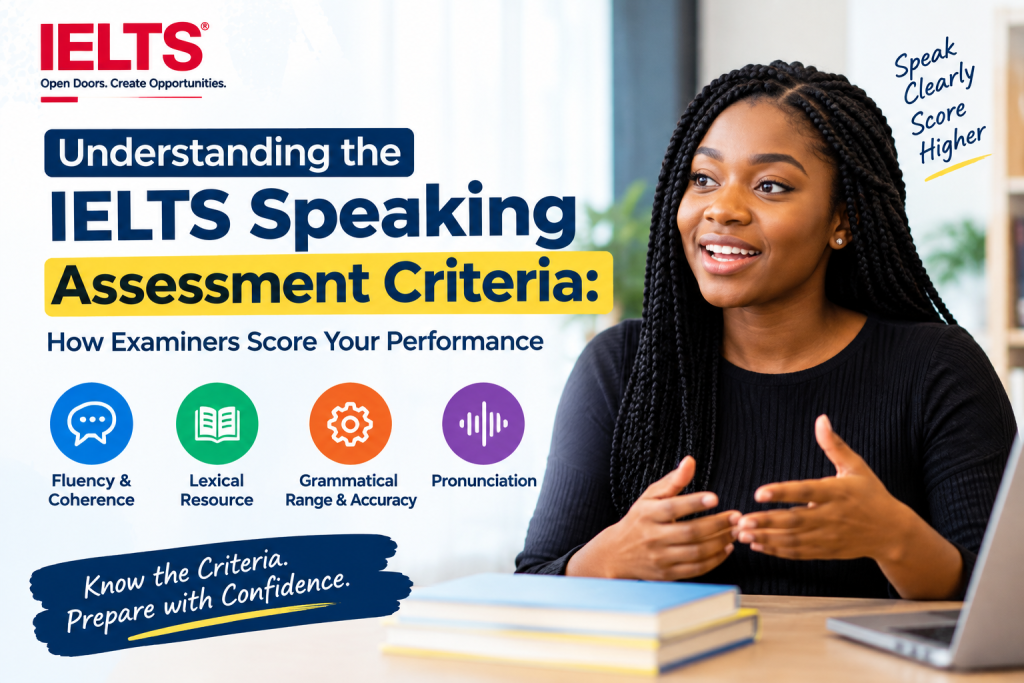
Understanding the IELTS Speaking Assessment Criteria: How Examiners Score Your Performance
Achieving a high score in the IELTS Speaking test is not simply about speaking English for a long time or using difficult vocabulary. Your performance is assessed using four important criteria: Fluency and Coherence, Lexical Resource, Grammatical Range and Accuracy, and Pronunciation.
Understanding these criteria can help you prepare more effectively because you will know exactly what the examiner is listening for.
1. Fluency and Coherence
Fluency means being able to speak naturally without too many unnecessary pauses, while coherence means presenting your ideas in a clear and logical way.
For example, if the examiner asks:
“Do you enjoy your hometown?”
A weak response might be:
“Yes… I like it. It is nice. There are many places. Yes, I enjoy living there.”
The answer is short and does not clearly develop the idea.
A better response would be:
“Yes, I really enjoy living in my hometown because it is relatively peaceful and the people are very friendly. Another thing I like is that most places are easy to reach, so I don’t have to spend too much time travelling. Although it can be quite busy during rush hour, I still enjoy living there.”
Notice how the speaker gives an answer, explains the reason, and adds another relevant point. This makes the response more developed and easier to follow.
Tip: Do not memorise long answers. Instead, practise developing your ideas using simple structures such as answer + reason + example + additional point.
2. Lexical Resource
Lexical Resource refers to your ability to use vocabulary accurately, appropriately, and flexibly.
You do not need to use extremely complicated words to get a good score. What matters is whether you can choose the right words to express your ideas clearly.
For example, instead of repeatedly saying:
“The city is nice. The people are nice. The environment is nice.”
You could say:
“The city has a pleasant atmosphere, the residents are welcoming, and the environment is relatively peaceful.”
Here, the speaker avoids unnecessary repetition and uses more precise vocabulary.
You should also learn how to use collocations, which are words that naturally occur together.
For example:
- make a decision
- heavy traffic
- strong interest
- highly recommended
- take responsibility
Using vocabulary naturally is more important than simply using difficult words.
3. Grammatical Range and Accuracy
This criterion focuses on how accurately you use grammar and how effectively you can use different grammatical structures.
For example, instead of using only simple sentences:
“I live in Asaba. I like Asaba. It is peaceful. I work there.”
You can connect your ideas:
“I have lived in Asaba for several years, and I enjoy living there because it is relatively peaceful. Although the city has become busier in recent years, I still find it a comfortable place to live and work.”
The second response demonstrates a wider range of structures, including present perfect, conjunctions, contrast, and complex sentences.
However, remember that complex grammar is only useful when you can use it correctly. It is better to produce a clear and accurate sentence than to use a complicated structure incorrectly.
4. Pronunciation
Pronunciation is not about speaking English with a British, American, or Australian accent. The important issue is whether the examiner can understand you easily.
For example, the words “ship” and “sheep” have different vowel sounds. If these sounds are not produced clearly, your meaning may become unclear.
You should also pay attention to:
- Word stress
- Sentence stress
- Intonation
- Individual sounds
- Linking between words
For example:
“I wanted to go to the cinema.”
Natural pronunciation involves connecting some words together rather than saying every word separately. Practising aloud and recording yourself can help you identify pronunciation problems.
How to Use the Four Criteria in Your Preparation
When practising IELTS Speaking, do not focus only on answering questions. Record yourself and evaluate your response using the four criteria.
Ask yourself:
Fluency and Coherence: Did I speak naturally and organise my ideas clearly?
Lexical Resource: Did I use a good range of appropriate vocabulary without unnecessary repetition?
Grammatical Range and Accuracy: Did I use different sentence structures accurately?
Pronunciation: Could someone understand me clearly without having to concentrate too much?
For example, if you are answering:
“Describe a memorable journey you have taken.”
Do not simply say:
“I went to Lagos last year. It was nice. I travelled with my friends. We had fun.”
Develop the response:
“One of the most memorable journeys I have taken was a trip to Lagos with two of my close friends last year. We travelled by road, and although the journey took longer than expected because of traffic, we had a great time together. What made the trip particularly memorable was that it was my first time visiting some of the places we went to. I also had the opportunity to meet some interesting people and try different kinds of food.”
This response gives you opportunities to demonstrate all four criteria: you can organise your ideas clearly, use a range of vocabulary, demonstrate different grammatical structures, and practise natural pronunciation.
Final Advice
The IELTS Speaking test is not a competition to see who can use the biggest words or speak with the most complicated grammar. The goal is to communicate your ideas clearly, naturally, accurately, and confidently.
If you understand the four assessment criteria and practise with them in mind, your preparation becomes much more purposeful. Instead of simply asking, “Is my English good?”, ask yourself, “Am I fluent? Am I using appropriate vocabulary? Is my grammar accurate? Can the examiner understand me clearly?”
That approach will help you become a more confident and effective IELTS Speaking candidate.